
How to Get Court Records
Pick the custodian first. The District Clerk function holds the files of the 118th District Court, while the County Clerk function keeps Constitutional County Court and probate records. Justice courts and Stanton Municipal Court answer for their own cases. The county-linked LGS search and re:SearchTX can surface an index, an event, or even a document layer for a Martin County court docket. Neither tool replaces the official custodian, though, so formal requests still go to the clerk.
- Identify the court, cause number, and exact document.
- Check LGS or re:SearchTX for a public record.
- Call the owning clerk to confirm availability and copy instructions.
- Inspect at the counter or confirm a mailed request.
- Choose a plain or certified copy and obtain the total.
- Supply payment and return instructions the clerk accepts.
You can reach the combined clerk at 301 N. St. Peter Street in Stanton. Phone contact works too, at 432-756-3412. Mail orders go to P.O. Box 906, Stanton, TX 79782 once the office confirms what you need. A fax number is published. But the office does not promise to accept copy orders that way. The clerk offers no general email, drop-box, or online request form.
Martin County Docket Documents
A docket is the index and running history of a case. It can name a filing without holding the paper itself. The court record behind it may run much deeper. Pleadings, citations and returns, motions, exhibits, affidavits, judgments, orders, transcripts, inventories, accountings, bonds, notices, and appellate material all appear in Martin County files. A public portal might show one layer of that stack and hide the rest.
- Docket
- The dated list of case events, settings, filings, and rulings.
- Document image
- A view or copy of the paper named by an event.
- Plain copy
- An ordinary reproduction without clerk authentication.
- Certified copy
- A copy authenticated by the clerk as a true copy.
Name the exact document and its date. Asking for "the whole file" can be costly or unclear, but a request like "the signed judgment entered on a stated date" gives the clerk a precise target.
Types of Court Records
What a file holds depends on the court. District cases may carry felony, major civil, family, juvenile, and child-protection material. Access limits still apply. County files cover misdemeanors, civil matters, probate, guardianship, and Commissioners Court records. Justice courts handle limited civil suits, evictions, fine-only misdemeanors, and magistrate work. Stanton Municipal Court keeps city ordinance, Class C, and traffic cases.
- Docket or register-of-actions entries
- Pleadings, motions, and notices
- Citations, service returns, and bonds
- Orders, judgments, and dispositions
- Public exhibits, transcripts, and appellate papers
- Public financial or cost entries
Not every record type is public in every case. Juvenile, DFPS, sealed, and other confidential materials call for a separate access analysis before a clerk will release them.
Martin County Certified Judgments
For a certified judgment, give the clerk the court, the exact cause number, the document title, and the order date. Be clear about whether a plain copy suffices or certification is required. Ask, too, whether the recipient needs exemplification, a more formal level of authentication. Martin County publishes no separate certified-copy form. It also makes no turnaround promise.
Who holds the clerk's office is in dispute on paper. The current county page lists Lali Ybarra as County & District Clerk. OCA verification and county minutes identify Linda Gonzales instead. Since the official sources conflict, call 432-756-3412 before addressing a formal request to a person. Route the request by office and court, not by a disputed name.
What a Court Record Contains
Content varies by document. A docket gives chronology. A pleading states a party's request or response. An order records a judge's ruling, and a judgment resolves all or part of the case. No safe sample Martin County case file is published, so the inventory here draws on court rules and official system descriptions without exposing private parties.
| Header | Cause number, court, county, style, case type, and filed date. |
|---|---|
| Participants | Public party roles, counsel, and judge information. |
| Chronology | Dated filings, notices, settings, orders, and disposition events. |
| Service | Citations, returns, appearance dates, and related papers. |
| Decision | Orders, judgment, verdict, or disposition. |
| Access | Image link, redaction, restriction, or availability notice. |
For a JP civil docket, Texas Rule of Civil Procedure 507.3 sets the required entries. The list includes the suit title, first process and return dates, appearances, papers, adjournments, trial and jury facts, verdict, judgment, and later motions or orders.
Mailing Martin County Requests
Mail works as a fallback, though the clerk publishes no mail checklist. Call first. Ask whether the file sits in the county-clerk or district-clerk capacity, whether it is on site, and how the office prices copies, certification, and postage. Then send a narrow written request to P.O. Box 906, Stanton, TX 79782.
List the cause number, court, and document title with its date. Add the desired format, certification choice, and return contact. Hold off on payment until the clerk states the amount and method. For a 118th District Court setting or administration question, the court's listed primary location is Big Spring and its coordinator uses 432-264-2225. The clerk can still confirm the proper record route.
Certified Copies and Fees
The county-linked fee sheet is official, but it is a scan with no date. Confirm all charges before paying. Copy fees must be kept apart from filing, service, citation, and sheriff fees. A free index search does not make a document image free. An image fee does not cover county certification.
| Item | Published amount | Caution |
|---|---|---|
| Plain paper copy | $1 per page | Miscellaneous district-fee line |
| County Records certification | $5 per instrument | Confirm the record and pages |
| District Records certification | $5 per instrument | Separate published line |
| re:SearchTX document | $0.10 per page, up to $6 as described | Repository access, not clerk certification |
| Listed process item | $8 | Not a copy fee |
The sheet also lists clerk certified-mail service plus postage, sheriff service, and writ service. Those charges cover filing or process work, not ordinary inspection of a Martin County court docket.
Martin County Rule 12 Boundary
Texas splits court records from judicial administrative records. Those are two different things. Under the Texas judicial open-records policy, Rule 12 governs only judicial administrative records. It offers no shortcut to a pleading, judgment, or case docket. Those adjudicative records belong with the clerk of the court that heard the case. The official Texas courts open-records policy spells out that divide.
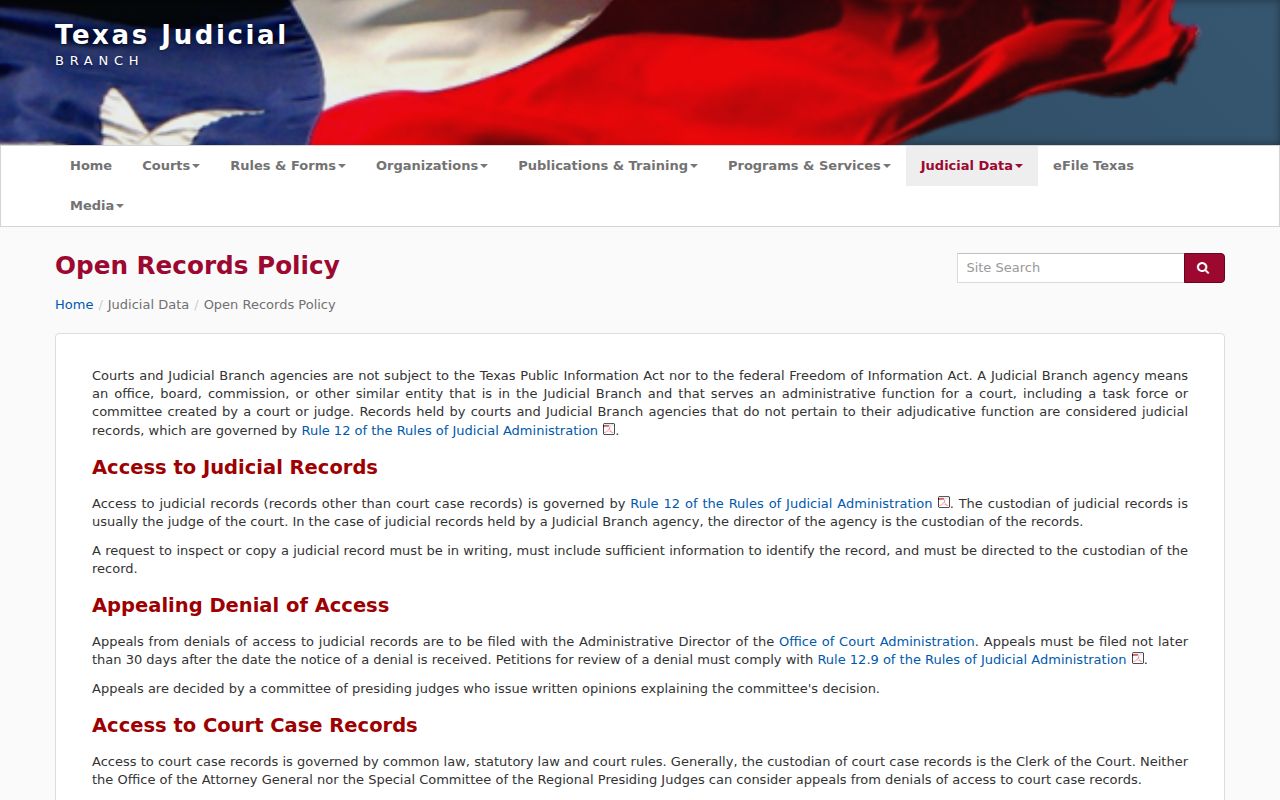
For a non-case administrative record, put the request in writing under Rule 12 and name the record and custodian. For a Martin County case file, give the clerk the cause number, court, date range, document, and preferred copy format.
Public Access and Sealed Records
Texas Rule of Civil Procedure 76a starts from a presumption. It is a strong one: court records stay open. Still, some Martin County materials sit behind statutes and orders. Texas Family Code section 58.007 shields juvenile court and clerk records from public view. The county also posts a standing order covering the confidentiality of DFPS court records. Read that order itself. Its terms control what the clerk can release from a Martin County court docket.
If a clerk denies access to part of a Martin County case file, ask which law or order blocks it and whether a redacted public copy exists. A Rule 12 request cannot override restrictions that attach to the case record itself.
Martin County Clerk Office
The combined county and district clerk office runs the main records counter for Martin County court files. Published hours are Monday through Thursday, 8:00 a.m. to 4:30 p.m., plus Friday, 8:00 a.m. to 12:30 p.m. The office stays open through lunch. Plan a docket or records visit around these clerk hours rather than the wider building schedule.
County & District Clerk
301 N. St. Peter Street
Stanton, TX 79782
Mail: P.O. Box 906
Phone: 432-756-3412
Fax: 432-607-2212
The county does not publish a public-terminal count, an email order route, or any stated identification rule, electronic-delivery policy, or turnaround time. Call ahead before counting on any of those. Older Martin County court records may still live in books, indexes, paper files, microfilm, or storage.